Splits and cracks
As felt ages it hardens and can split, especially along seams and at any point where the deck flexes.
Split felt, blisters, lifted edges and tired joints are the classic faults on older flat felt roofs around Ormskirk. Compare free quotes from roofers who can repair or recover them.
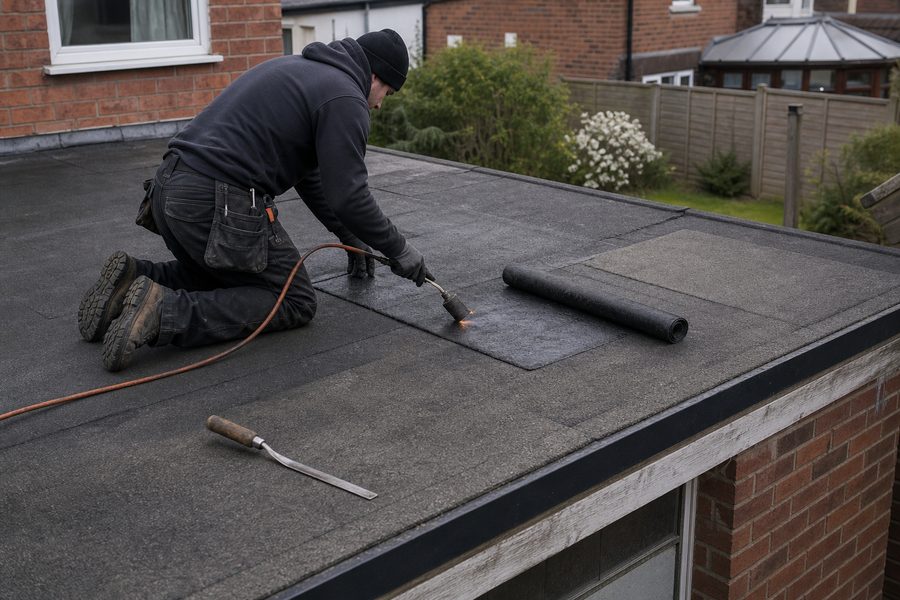
Built up felt fails in recognisable ways, so a roofer looks for the typical signs of a covering reaching the end of its useful life.
As felt ages it hardens and can split, especially along seams and at any point where the deck flexes.
Trapped moisture or air lifts the felt into blisters that eventually crack and let water into the layers below.
Lifted edges, tired drip trims and failed upstands are common entry points, particularly on exposed roofs.
Built up felt has covered flat roofs across Ormskirk for decades, and plenty of it is still in place on garages, extensions, porches, dormers and outbuildings. When it is fitted well and looked after, felt does a reliable job. The trouble is that it has a working life, and a lot of the felt roofs around the area are now well into theirs.
The signs are familiar. The surface goes hard and loses its flexibility, blisters appear where moisture is trapped, seams open up and the edges start to lift. On the open plain, where these low roofs sit fully exposed, wind and driving rain find a lifted edge or a tired seam quickly. Once water gets into the layers of a built up felt roof it can travel a long way before it shows inside, which is why felt leaks can be tricky to pin down.
A single split on a sound roof is worth repairing. Widespread blistering, brittle felt and several leaks usually point towards recovering the roof. A roofer can advise which makes sense for your roof and budget.
Get a QuoteThe choice between repair and recover comes down to how much life is left in the rest of the covering.
A localised split or an open seam on an otherwise sound roof can be cut back, cleaned and re-bonded with fresh felt or a compatible repair system. Done properly this restores the watertight line and can keep a serviceable roof going for a good while longer.
Blisters are cut, dried out and patched so they cannot crack and let water in. If a roof is covered in blisters, though, it is usually a sign the covering is failing more widely and recovering may be the better long term answer.
Lifted edges, tired drip trims and the upstand where the felt turns up against a wall are frequent leak points. Re-dressing and re-bonding these details, and renewing trims where needed, closes off some of the most common felt roof leaks.
When felt has gone brittle, split in several places or reached the end of its life, repeated patching tends to chase the problem around. Stripping the old covering and recovering in fresh felt, or upgrading to a single ply or fibreglass system, gives a clean, reliable roof and often better value over time.
Built up felt is designed to shed water, not hold it, so a roof where water sits in pools after rain tends to wear faster and fail sooner. Standing water points to a shallow fall, a settled deck or a blocked outlet, and the mineral surface in those areas often breaks down first. A roofer can improve the fall or the drainage as part of the repair so the new or repaired covering is not left sitting under water every time it rains.
Felt roof work overlaps with these repairs. These pages may help.
It varies with the quality of the felt, how well it was fitted and how exposed the roof is. Many built up felt roofs last around fifteen to twenty years. An exposed, poorly detailed roof on the open plain may have a shorter life.
A few blisters can be cut, dried and patched. If the roof is covered in them it usually means the covering is failing more generally, and recovering the roof tends to be the more lasting solution.
Water that gets into a built up felt roof can travel between the layers and along the deck before it drops, so the leak inside often appears some way from the actual fault. Tracing it back is part of the repair.
Modern torch on felt systems are durable and cost effective when fitted well. For some roofs, rubber or fibreglass may suit better. A roofer can compare the options for your particular roof.
Temporary repairs can usually be made to stop water coming in, but some felt systems bond best in dry, milder conditions. A roofer can make the roof safe now and complete a lasting repair when the weather is suitable.
Get free, no obligation quotes from roofers covering Ormskirk and the surrounding villages.
Get a Quote