Seams and joints
Laps in felt, welded joints in rubber and bonded overlaps in fibreglass are the first things to open up as a covering ages, so they are checked closely.
Felt, rubber and fibreglass flat roofs over Ormskirk extensions, dormers, garages and porches all fail in their own way. Compare free quotes from roofers who can trace the fault and price the right repair.
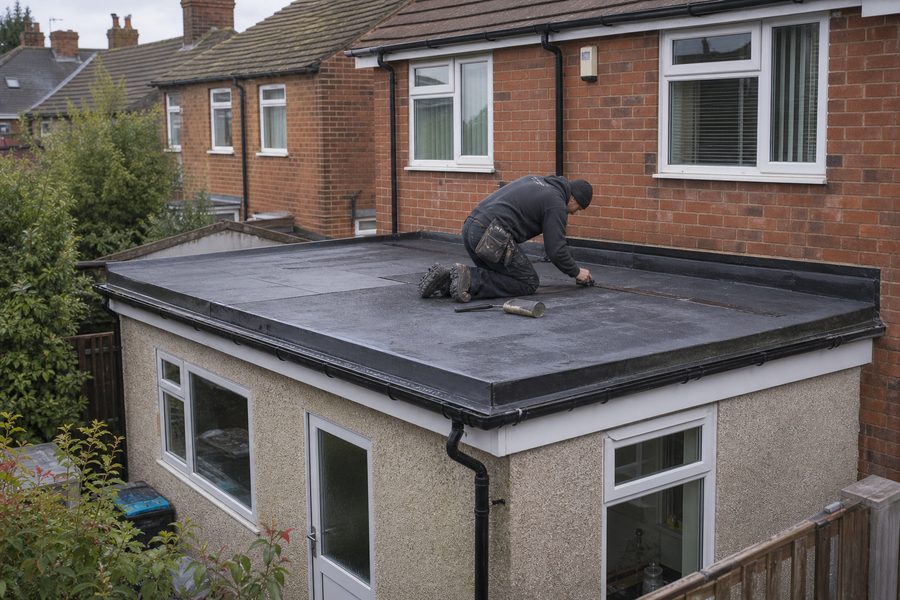
A flat roof rarely leaks where the stain appears inside, so a roofer works back from the damp patch to find the real entry point.
Laps in felt, welded joints in rubber and bonded overlaps in fibreglass are the first things to open up as a covering ages, so they are checked closely.
The point where the flat roof turns up against a wall, and the outlets that drain it, are common leak sources once seals tire or debris collects.
Standing water shows the roof is not draining as it should. A roofer notes where it pools and if the fall or the outlet needs attention.
Flat roofs are everywhere across Ormskirk, even on homes with a pitched main roof. Many inter-war and post-war semis around the town gained rear extensions, kitchen additions, dormers and porches over the years, and most of these were finished flat. Detached and semi-detached garages, common across the wider L39 and L40 area, almost always carry a flat covering as well.
The coverings fall into three broad groups. Older roofs tend to be built up felt, sometimes mineral finished, which can blister, split and lift at the edges as it weathers. Mid life roofs are often EPDM rubber, a single sheet that usually fails at joints, bonded laps or the upstand rather than across the middle. Newer or recently recovered roofs are frequently GRP fibreglass, which is durable but can crack at stress points, trims and badly formed corners.
Because the West Lancashire Plain is so open, these low roofs sit fully exposed to wind and driving rain. That exposure tends to find a tired seam or a lifted edge quickly, which is why a flat roof can go from a minor weep to a steady drip in a single wet spell.
Felt, rubber and fibreglass all look similar from the ground. A roofer can identify the covering on a visit, but a quick note about blistering, lifting edges, standing water or a crack near an outlet helps when you request quotes.
Get a QuoteThe repair route depends on the covering, the size of the fault and how much of the roof has reached the end of its life.
When the rest of the covering is sound, a localised repair is often the sensible answer. On felt that can mean cutting out a split, re-bonding a lifted lap or sealing around an outlet. On rubber it can mean cleaning back and patching a failed joint or upstand. On fibreglass it can mean grinding out and re-laminating a cracked area. A good repair restores the watertight line without disturbing a covering that still has years left in it.
If a flat roof has multiple splits, widespread blistering or the felt has gone hard and brittle, repeated patching tends to chase the leak around. In that case it is often better value to strip and recover the section in a modern single ply or fibreglass system, with proper upstands and a new outlet detail, so the same problem does not return each winter.
A surprising number of flat roof leaks come down to water that cannot get away. Blocked or undersized outlets, a poor fall or a failed junction where the flat roof meets the house wall all let water sit and work its way in. Sorting the detailing is often as important as the covering itself, particularly on extensions tucked against the main building.
Flat garage and outbuilding roofs are a job of their own. Many are old felt on timber decks that have softened underneath. A roofer can advise if a patch will hold or if the deck and covering need replacing, which matters for any building used to store a car, tools or equipment.
Flat roof problems often sit alongside other repairs. These pages may help.
It depends on the system and how exposed the roof is. Older felt may last around fifteen to twenty years, while modern rubber and fibreglass systems can last considerably longer when fitted well. The open, windy aspect across much of the area can shorten the life of a poorly detailed roof.
Often yes for make safe and many repairs, though some coverings need dry, mild conditions to bond properly. A roofer can carry out a temporary repair to stop water coming in and return for a permanent fix when the weather allows.
That usually points to drainage or a detail rather than a hole. In heavy rain water backs up at a blocked outlet, a low spot or an upstand and finds a way in that it does not reach in lighter showers.
Both are durable when fitted correctly. Rubber suits larger, simpler roofs and copes well with movement, while fibreglass gives a hard, joint free finish that suits smaller roofs and complex shapes. A roofer can advise based on your roof and budget.
Not always. A sound deck can sometimes take a new covering over the top, but a soft or damaged deck, or several old layers, usually need stripping back so the new system has a solid base.
Get free, no obligation quotes from roofers covering Ormskirk and the surrounding villages.
Get a Quote